Point bar vs mid-channel bar: field marks that actually tell them apart
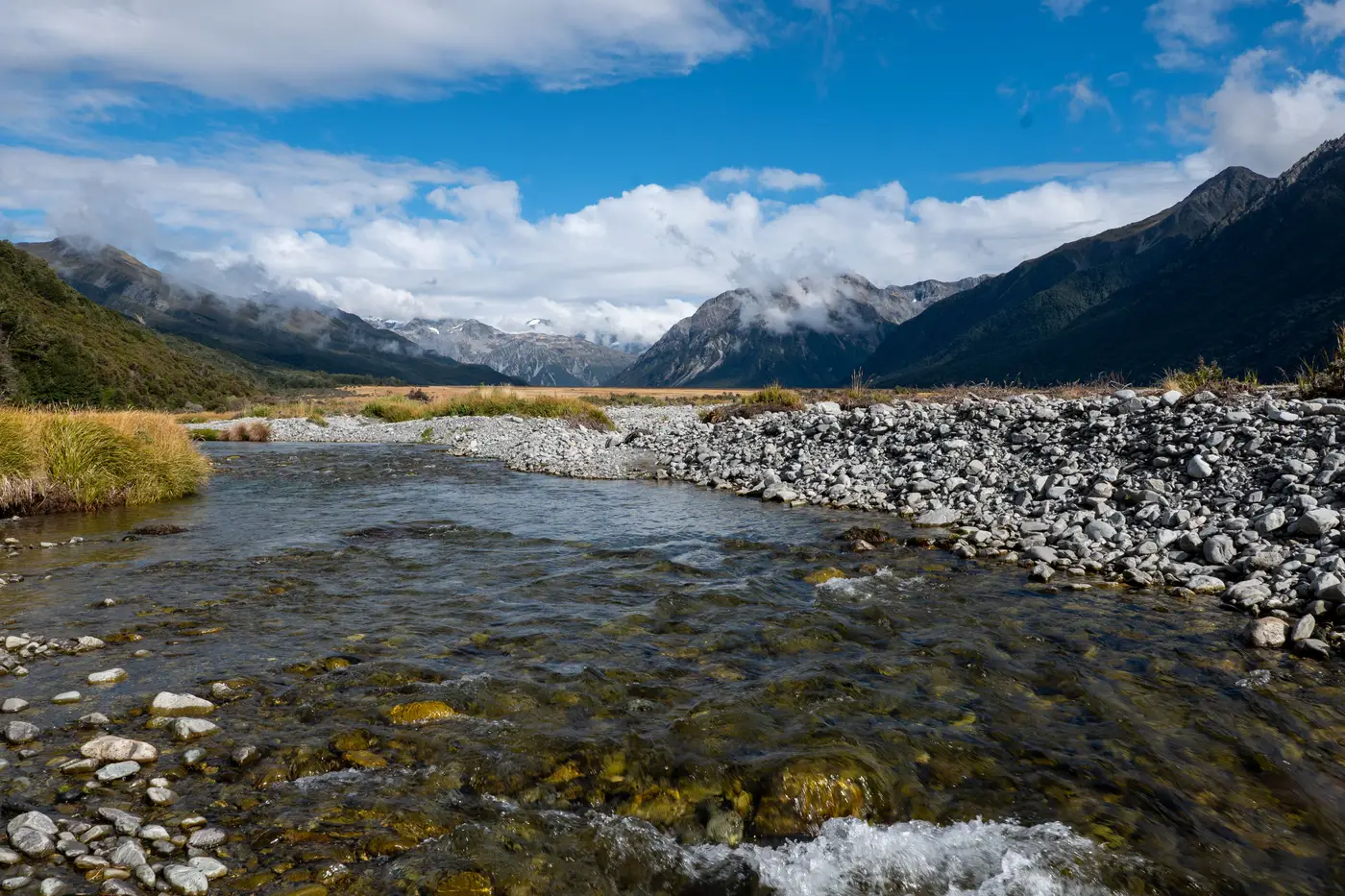
Two bars can look nearly identical from the bank and mean completely different things about how a reach is behaving. Get the call wrong and you'll misread whether a channel is meandering normally or starting to braid.
Where the bar sits tells you most of the story
A point bar forms on the inside of a meander bend, attached to the bank, built up by lateral accretion as the thalweg sweeps past the outer bank and drops its load on the inner one. It's asymmetric in plan: a gentle slope on the upstream and inner side, a steeper cutbank-facing edge downstream. Walk the surface and you'll usually find a scroll-bar pattern, those low arcuate ridges and swales that record successive positions of the bend as it migrated. If you can trace that ridge-and-swale topography, you're standing on a point bar, full stop.
A mid-channel bar, by contrast, isn't attached to either bank. Flow splits around it on both sides. These show up in braided and transitional (wandering) reaches where sediment supply outpaces the channel's capacity to move it through in one thread. Shape tends toward symmetric or lozenge-shaped, often with a blunt upstream nose that takes the brunt of flow and a tapering tail downstream where the two threads rejoin. If you can walk all the way around a bar without crossing a channel margin onto dry floodplain, it's mid-channel.
The practical shortcut: point bars need a meander bend to exist. No bend, no point bar. Mid-channel bars need the opposite condition, enough sediment load relative to transport capacity that the channel can't keep a single thread open.
Grain size and vegetation as the tiebreaker
In a low-sinuosity reach where the planform alone doesn't settle the call, grain sorting does. Point bars show a clear fining-upward and fining-landward sequence: coarser material near the channel edge, progressively finer sand and silt toward the scroll ridges furthest from the active thalweg. That sorting reflects decreasing competence as flow depth drops across the point during a falling stage.
Mid-channel bars are messier. Because they're built by rapid deposition during high flow and reworked from both sides on the next event, you'll often find coarse gravel or cobble lenses sitting next to finer patches with no consistent landward trend. Vegetation tells a similar story: point bars often carry an age-graded sequence of willow or cottonwood recruitment (youngest nearest the channel, oldest furthest back toward the floodplain, if the scroll pattern is old enough), while mid-channel bars are more likely to be bare or carry a single cohort that got wiped and recolonised together after the last event that reshaped the whole bar.
Other bar types worth knowing before you call it
A few related forms get lumped in with these two and it's worth keeping them straight. Lateral bars attach to a bank like point bars but occur in straighter reaches without a meander bend driving them; they're more a function of local bank irregularity or an obstruction than of migration. Longitudinal bars are elongated parallel to flow, typically mid-channel, and common in gravel-bed braided systems. Transverse bars sit oblique or perpendicular to flow and are often a transitional stage, sometimes a point bar or mid-channel bar caught mid-formation before the next event finishes the job.
None of this classification is academic. Bar type and position are a direct readout of what a high-flow event just did to sediment deposition in the reach. A point bar growing and the cutbank opposite it retreating means lateral migration continuing as expected. A new mid-channel bar appearing where none sat before means sediment supply has shifted and the channel may be starting to split. Knowing which one you're looking at, and where it sat before the last event, is what tells you whether a flagged reach needs a crew in the water this week or can wait for the next scheduled walk.
That's the comparison a before/after pair of the reach is built to answer without putting a boat in the water first; see what a paired image and outline set for your reach looks like after the next flow event.